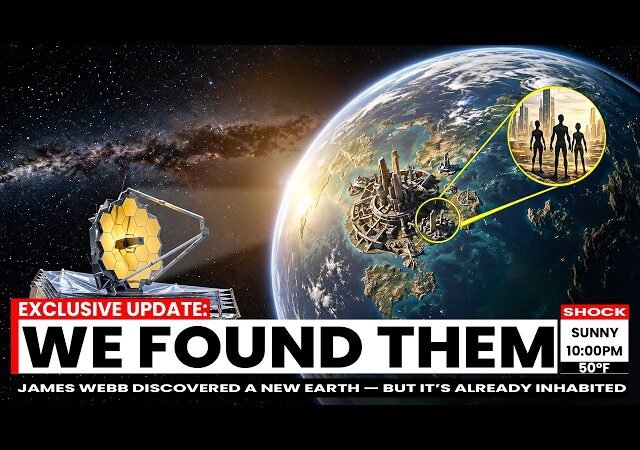
We may have already found alien life. For decades, humanity searched the cold voids of the cosmos for another Earth—a distant world with oceans, clouds, and the perfect conditions for life to blossom. But the James Webb Space Telescope (JWST) has just pointed its massive golden mirror at an exoplanet that might have beaten us to the finish line.
Located 120 light-years away in the constellation Leo, a massive world named K2-18b is rocking the scientific community. It sits directly inside the habitable “Goldilocks Zone,” but recent atmospheric readings from JWST have revealed something unexpected: a thick, hydrogen-rich sky saturated with methane, carbon dioxide, and a highly controversial biosignature—dimethyl sulfide (DMS). On Earth, this specific compound is overwhelmingly produced by one thing: living marine phytoplankton.
In this deep dive, we investigate the Hycean Planet Theory and crack open the data behind K2-18b. We also look at the broader, staggering reality facing modern astrobiology: from precursors to RNA discovered floating around baby stars in V883 Orionis, to the dark, sunlight-free marine ecosystems thriving inside Jupiter’s moon Europa and Saturn’s Enceladus.
LIKE, SUBSCRIBE, and drop your theory in the comments: Do you think K2-18b’s oceans are teeming with alien life, or is this just an illusion of deep-space chemistry?
